
AI Video Production: What Can It Replace in 2026?
We are in exciting times!
By 2026, nearly every stage of video production will have had at least one AI-powered tool promising automation, speed, and efficiency.
From drafting scripts to generating B-roll to editing entire rough cuts, AI is no longer a novelty. It’s part of the workflow.
AI can assist video production quite well, AI video production workflows to be more specific, but it can’t replace the ones who make video emotional, and strategic – aka the magic!
At UpMedia, we embrace AI where it helps, and ignore it where it hurts storytelling. That’s the balance brands need in 2026 and this blog is designed to help you understand those nuances.
What AI Can Replace in Video Production?
Let’s start with the obvious. AI really can make certain parts of video production faster, smoother, and more cost-effective. Not by taking over, but by removing the repetitive tasks that slow things down.
1. Script Assistance & Content Ideation
If you’re having trouble with a particular script, AI can help. Give it the first draft of your script or even your main talking points, and it can kick out script outlines, alternative angles, tone variations, and even full first drafts.
What it can do:
- Generate script ideas
- Suggest hooks, titles, and narrative structures
- Repurpose long-form content into short-form scripts
What it can’t do:
- Completely write your script for you
- Understand your brand on a personal level
- Know what your audience actually likes
- Craft emotional nuance
That last part still requires humans, and always will. Regardless of how intelligent AI gets, it’s important that this stage of AI video production always includes the human touch!
This is literally the key difference maker in an AI-enhanced video project.
2. Pre-Production: Shot Lists & Visual Planning
AI image platforms can help mock up slick cinematic mood boards in record time.
How this helps:
- Faster planning
- Clearer visual expectations
- Better client communication
Here are some tools I’d recommend for creating cinematic mood boards for your video production.
Great for moody, stylized, cinematic images with lots of control via prompts. Excellent for lighting, atmosphere, colour palettes.
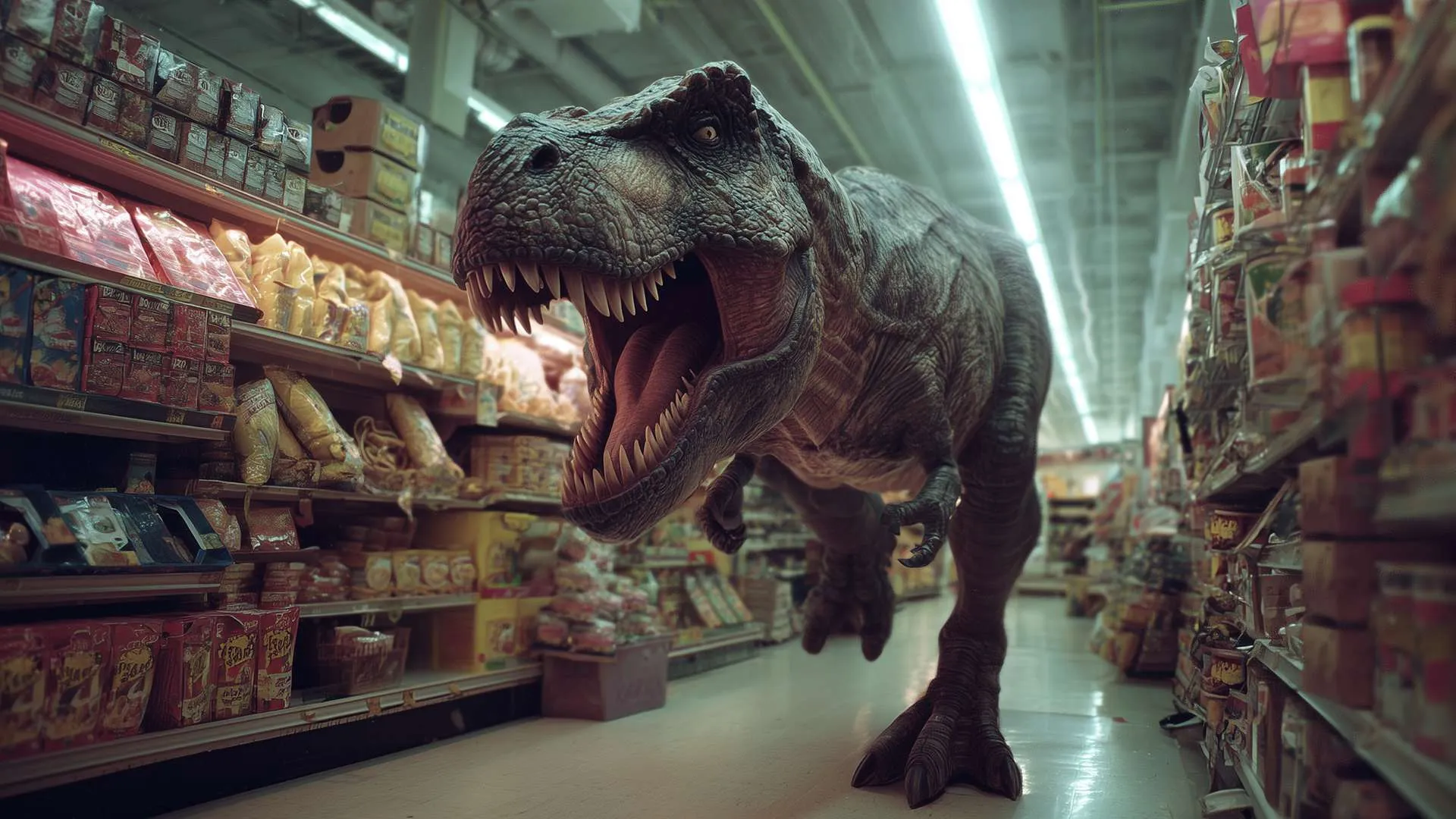
Here’s an example of some images we generated with the prompt of a T-rex running through a grocery store:

Ran locally or via cloud, lets you iterate fast with custom styles or image-to-image chaining, perfect for evolving a mood board.
Offers tools for stylizing and iterating images; good if you want a consistent cinematic aesthetic across multiple visuals.
Nano Banana
A newer AI image tool gaining traction for its ability to generate highly specific cinematic references with minimal prompting. It excels at producing realistic lighting scenarios, lens-based looks, and scene compositions that closely mimic real-world filmmaking. Nano Banana is especially effective for video production teams who want mood boards that feel grounded, not overly stylized, making it an excellent companion to the more artistic platforms above.
Still, AI image platforms have a tendency to create overly epic looking images, which aren’t always necessary. Not every shot in your video production needs to be grandiose (unless you’re doing a spot for Redbull, or something).
Make sure you use the human touch to discern when simplicity is a better option.
3. Editing: Rough Cuts, Transcriptions & Subtitles
If there’s one area where AI has saved producers countless hours, it’s editing.
AI tools can now:
- Select specific takes
- Remove dead space
- Generate subtitles and captions instantly
- Align multi-cam footage
AI rough cuts are often decently good. But they lack intention. They miss the pacing, emotional build, and narrative timing that make a video watchable, memorable, and brand-aligned.
What still needs “the humans”:
- Colour grading with emotional intention
- Story pacing and rhythm
- Music selection that enhances tone
- Fine-tuning cuts to maximize viewer impact
4. AI B-Roll, Stock Footage & Motion Graphics
Now, this is where AI can really come in handy, especially if you have someone on your team who has embraced AI video.
Need a quick clip of a city skyline or abstract tech animation? AI tools can generate those in a compelling fashion. This is especially helpful when creating explainers or filling gaps in corporate video production.
AI videos are definitely starting to replace stock video, and even produce decent custom B-roll (storytelling) shots. And if you have a subscription and enough credits, you can save money on expensive stock video memberships.
I will note that in order to stay competitive with AI videos, stock image and video sites are now incorporating their own AI videos. So it’s just a matter of choosing which platform gives you the best bang for your buck, and also what specifically you need it for.
If you’re a business hiring a video production company, consult with them on which they prefer and might have experience with.
Great for:
- Placeholder footage
- Conceptual animations
- Fast prototyping
Risky for:
- Anything requiring brand accuracy
- Footage involving people
- Anything legally sensitive
Here are my recommendations for which platforms to consider for AI video production:
Artlist
A polished all-in-one platform for creating AI-assisted corporate videos using generated visuals, stock footage, music, SFX and templates.
Veo 3
A powerful text to video model that quickly produces concept videos, training moments or social-ready clips with minimal input.
Midjourney
An artistic generator you can use to create cinematic images and then animate them into short stylized video moments.
This AI generated clip shows a T Rex charging through a grocery store, knocking over displays and sending products flying. It’s a simple but powerful example of how AI video production can create wild scenarios quickly, making it perfect for prototyping concepts or grabbing attention in early stage creative.
What AI Can’t Replace in Video Production
This is where things get interesting. Because while AI excels at predictable, repeatable tasks, it struggles in areas that require emotional intelligence, creativity, leadership, or lived experience.
1. Brand Strategy & Emotional Storytelling
A compelling video isn’t just a collection of scenes, it’s a strategic narrative shaped by human insight. And while AI can access information about your brand, it doesn’t excel at high-level, expert video strategy.
AI can generate scripts and surface ideas, but it struggles to:
- Understand audience nuance and emotional hooks
- Craft messaging based on your business goals
- Interpret company culture in a meaningful way
AI can’t sit in a discovery call, listen between the lines, or sense when a certain idea resonates with your team. It can’t build trust, ask follow-up questions, or uncover the deeper emotional angle that makes a story exceptional.
That blend of strategic thinking and genuine human connection is what turns an ordinary video into a powerful, intentional piece of communication, and that still requires human experience and intuition.
2. Directing Real People
Whether you’re interviewing an executive, filming a customer testimonial, or managing a team of actors, directing is human work.
Film Directors:
- Build trust on set
- Calm nervous talent
- Draw out honest performances
- Make real-time adjustments
AI cannot walk into a room and help someone feel comfortable being on camera, or sense what really needs to be said with or without the script. That alone keeps humans essential.

3. Cinematography & On-Set Creativity
On a real set, things change minute by minute. Light, sound, location challenges, weather, unexpected noise, and AI can’t react to physical unpredictability.
Cinematographers make hundreds of micro-decisions:
- How should light fall on the subject?
- Should the camera move or stay still?
- What lens best fits the emotion of the scene?
These decisions shape the identity of your video, and they are largely intuitive, by the Director. They can’t be automated, not without losing artistry.
4. Authentic Human Performance
AI-generated avatars exist, and they’re improving fast. But that said, they’re still obviously AI. Brands overwhelmingly prefer real humans, real employees, real customers, real leaders.
Authenticity still wins trust in today’s video landscape. And let’s hope it stays that way.
How We Blend AI With Creativity in Video Production
At UpMedia we use AI thoughtfully, not to replace filmmakers but to supercharge them.
We use AI for:
- Storyboards
- Subtitles
- Workflow
We rely on humans for:
- High level strategic storytelling
- Scriptwriting
- On-set direction
- Cinematography
- Narrative editing
- Brand-aligned creative decisions
Clients benefit from:
- Faster turnaround times
- Lower production inefficiencies
- More creative focus
- Clearer communication
- High-quality videos that feel thoughtful, not generic
Here’s a 20 second video paid ad we made for Powerpsych.com using Midjourney, blended with real photos and After Effects text animation.
AI Video Production in 2026
AI video production has earned its place in today’s media industry. It speeds up workflows, reduces friction, and frees creative teams to do what they do best.
But in 2026, and for the foreseeable future, the most successful videos will still be the ones shaped by human strategy, empathy, and imagination. AI will continue expanding into animation, VFX, sound design, and pre-visualization. The tools will get smarter, cheaper, and more accessible.
But brands will still want and need:
- Human-driven stories
- Genuine people
- Emotional truth
- Creative direction
- Strategic guidance
In other words: AI will automate the tasks, but humans will continue to shape the meaning.
If you’re ready to create videos that combine modern AI efficiency with timeless storytelling, UpMedia is here to help.


